
Crash guides
Crash payout limits: four numbers with different jobs
Separate maximum stake, return, multiplier and round caps. Work through decimal examples, stake-inclusive returns and rounding rules.
Aarav Sharma · Updated · 4 min read
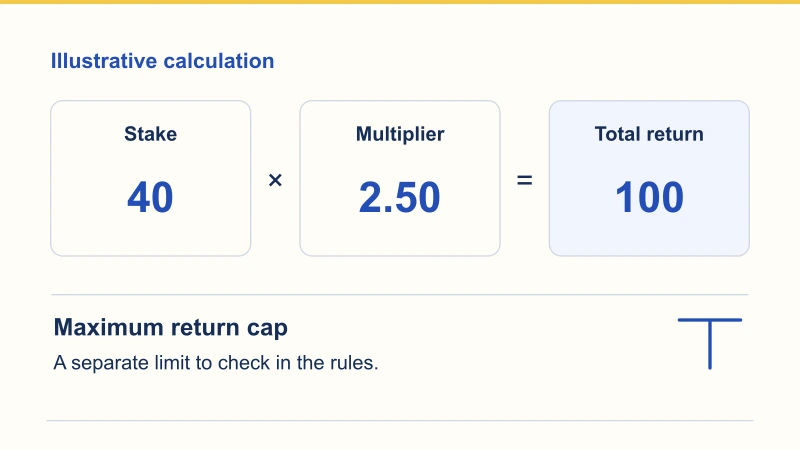
Begin with what the maximum actually limits
A large multiplier and a maximum payout are not interchangeable. One is a factor; the other is an amount with a currency and a defined scope. A maximum stake is different again: it restricts an entry, not its eventual result. Start by writing each limit beside its unit. All rupee amounts here are fictional arithmetic examples, not tested Master Crash limits or a claim that this APK supports a particular currency. An upper limit also says nothing about the likelihood of reaching it.
Give each limit a unit and a scope
A hypothetical ₹100 maximum stake could apply to one entry. It would not, by itself, identify a maximum account balance or a withdrawal limit. A maximum multiplier needs another question: does it end the round, limit an entry’s payout calculation, or only restrict an auto-cash-out setting? Those are different controls. Likewise, “round cap” needs a definition: a monetary cap per player in one round is different from a shared limit across everyone. Copy the surrounding sentence rather than keeping only the largest number.
| Label | Unit | Scope to establish | Different from |
|---|---|---|---|
| Maximum stake | Money or credits | Each entry or combined commitment | Maximum return |
| Maximum return | Money or credits | Per entry; stake included or excluded | Multiplier ceiling |
| Maximum multiplier | × | Round endpoint, calculation or setting | A currency amount |
| Round cap | As defined in the rule | Per player or all participants; aggregation | Daily withdrawal limit |
Calculate total return before calling it profit
Suppose a fictional settled entry records ₹37.50 at 2.36×, with the return defined as including the stake. The calculation is ₹37.50 × 2.36 = ₹88.50. The net result is ₹88.50 − ₹37.50 = +₹51.00. Calling ₹88.50 profit would wrongly include the returned ₹37.50 stake in profit. These figures assume that the stated multiplier is the settled value and that no other adjustment applies. They do not calculate a result from the multiplier shown after the entry had already closed.
A ₹600 cap can produce two different answers
Now use the same ₹37.50 stake and an illustrative 20.00× settled factor. The uncapped total would be ₹750.00. Under a rule capping total return at ₹600, the credited amount would be ₹600 and the net result +₹562.50. Under a different rule capping net profit at ₹600, the total would instead be ₹637.50. Both examples use the number 600; the definitions produce different answers. Neither rule is asserted for Master Crash. A label such as “maximum win” needs its accompanying definition before this calculation is possible.
Check whether multiple entries share one ceiling
Imagine two entries whose separately calculated returns would be ₹600 and ₹500. Their combined return is ₹1,100. A ₹600 cap per entry would not itself reduce those amounts. A separate ₹1,000 cap per player per round would raise an additional question about the combined result. The rules would need to explain which amount is adjusted and how. Do not assume equal splitting, proportional reduction or payment in request order. A limit applying across all participants would be yet another scope, requiring its own allocation explanation.
Let the written rule decide the rounding
Decimal arithmetic can expose another difference. ₹12.35 × 1.37 = ₹16.9195 before currency precision is applied. A rule rounding to the nearest paisa would produce ₹16.92; a rule cutting off digits after two decimal places would produce ₹16.91. This is a comparison of methods, not a choice the player can make. Also establish whether rounding happens per entry or only after amounts are added. Keep the displayed precision and the calculation order in your note; a calculator alone cannot supply the missing rule.
Keep one example that support can reconcile
For a mismatch, save the game name, rule version or capture date, currency, round reference, entry reference, stake, recorded settlement factor and credited amount. Include the exact sentence defining the cap and any rounding provision. Ask “Which limit and calculation were applied to this entry?” A redacted record is more useful than a screenshot of a public high-multiplier round. A daily withdrawal ceiling would answer a different question: it concerns moving account funds out, not calculating the result of this entry.
What the reference sources establish
SPRIBE describes Aviator as a rising-multiplier game with an in-round cash-out action. That description does not supply this website’s payout settings. UKGC RTS 2 discusses clear transaction values; RTS 3 addresses rules and payout information. They are British reference standards, not Indian legal conclusions or certification of this APK. The worked examples above are our own explanations of why labels matter. To resolve an actual amount, the applicable product rules and the matching settlement record must provide the missing definitions.
Questions readers ask
Does a maximum stake tell me the maximum payout?
No. It describes an entry limit. The payout calculation, applicable return ceiling and scope must be established separately.
Can I calculate net profit by subtracting the stake?
Yes in the illustrated calculation where total return includes the stake and no other adjustment applies. First establish that the displayed amount really is that total return.
Should a small rounding difference always be ignored?
No. Compare the stated precision and rounding order with the record. A small difference deserves an explanation; it does not establish which method the product uses.
 Aarav Sharma
Crash mechanics & rule guides
Covers Crash multipliers, cash-out terminology, round records and the evidence behind game claims.