
Crash guides
Crash game RTP: what the percentage tells you
Understand Crash RTP with a rupee ledger, the difference between stakes and deposits, and why a published percentage cannot promise a session result.
Priya Mehta · Updated · 4 min read
97% does not mean 97 winning rounds
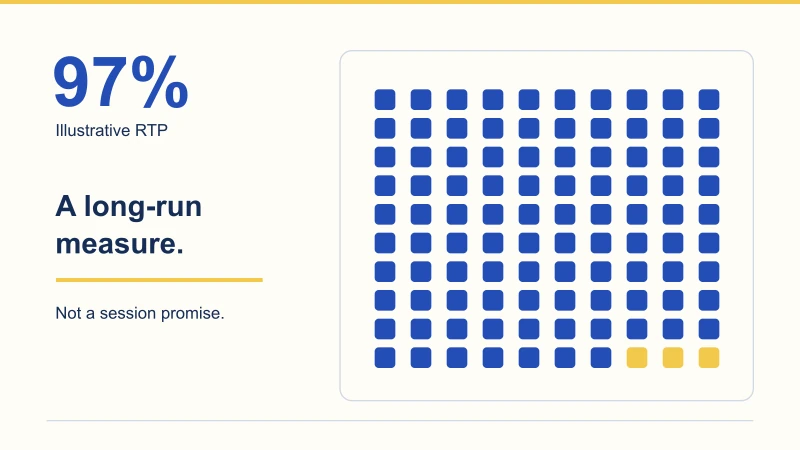
RTP stands for return to player. The UK Gambling Commission’s consumer guide describes it as an average across extensive play, rather than a promise for one session. A percentage beside a Crash game therefore needs a denominator: money wagered, not the number of rounds won. Three separate questions are often mixed together here: how frequently a result pays something, how much it pays, and how much comes back overall. A single percentage cannot answer all three. Start by identifying which question a chart or claim is actually answering.
Use the stake total, not the deposit
Take an invented account with ₹500 available. Its three recorded stakes are ₹100 each, and its total returns are ₹0, ₹240 and ₹0. Assume those returns include any returned stake and there are no other transactions. The wagered total is ₹300; returns add up to ₹240. For this small record, ₹240 ÷ ₹300 × 100 gives 80%. The balance is now ₹440, a ₹60 loss. Dividing ₹240 by the ₹500 deposit would instead give 48%, but that answers the wrong question. Depositing money and staking money are separate events. These numbers are a paper ledger, not Master Crash results.
What a published percentage would mean in rupees
For a purely hypothetical game with a theoretical RTP of 97%, ₹10,000 in total stakes corresponds to ₹9,700 in expected total returns under the stated model. The difference is ₹300. Expected is doing real work in that sentence: it is not a scheduled payment, a protected balance or the amount one person must receive. You cannot turn the calculation into a promise by dividing everything by 100. Nor does reaching ₹10,000 in personal stakes trigger a correction. The example explains the units of the percentage; it does not set a spending target.
| Paper ledger | Stake | Total return |
|---|---|---|
| Entry 1 | ₹100 | ₹0 |
| Entry 2 | ₹100 | ₹240 |
| Entry 3 | ₹100 | ₹0 |
| Total | ₹300 | ₹240 |
A design figure and a measured result are different numbers
The UKGC distinguishes a game’s theoretical RTP from its actual RTP over a selected record. The first belongs to the game model; the second is calculated from recorded stakes and returns. Our three-entry example produced 80%, but three entries cannot establish the underlying game model. An actual-return claim also needs its dates, included rounds and treatment of cancelled transactions. Leaving out a losing day changes the measurement. When comparing two published figures, matching the measurement period and inclusion rules matters more than the number of decimal places printed beside them.
The same average can hide very different results
Here are two invented sets of 100 equally likely tickets, each costing ₹10. Set A has 50 tickets returning ₹19.40 and 50 returning nothing. Set B has 10 tickets returning ₹97 and 90 returning nothing. Both sets distribute ₹970 against ₹1,000 in ticket costs: 97%. Yet a nonzero return appears on half the tickets in A and only a tenth in B. These are finite classroom examples, not Crash payout tables. They show why a return percentage alone cannot describe the spread of outcomes or how a short run may feel.
The missing 3% is not a fixed fee on every round
On the same gross-return basis, subtracting a 97% theoretical return from 100% leaves a 3% theoretical house edge. That does not mean a game deducts exactly ₹3 from each ₹100 stake and refunds ₹97. Individual results can differ sharply from the average. For the same hypothetical 3% edge, ₹1,000 and ₹5,000 of total stakes correspond to expected gaps of ₹30 and ₹150 respectively. Reusing a balance creates more turnover. Repetition therefore does not make an earlier loss a debt the game owes you; it creates additional exposure to the game’s mathematics.
A list of crash points is not a return statement
Suppose a history strip contains 1.20×, 2.10× and 8.00×. Averaging those three numbers gives approximately 3.77×, but it does not produce RTP. The strip does not say how much was staked or which individual actions settled. A round ending at 8.00× is not evidence that every participant received eight times a stake. This is a data problem before it is a statistics problem: a column of end multipliers cannot replace the amounts required for a return calculation. A screenshot of several large outcomes has the same limitation.
Keep the percentage attached to its named product
SPRIBE’s official Aviator page publishes 97% RTP. That is a statement about Aviator, not a universal figure for Crash games and not an established value for the APK linked by Master Crash. Similar aircraft artwork or a rising multiplier does not transfer one product’s mathematics to another. An APK’s version, size and SHA-256 identify a download; they do not supply a payout model. For a product-specific percentage, the useful reference is the named game’s current rules or technical disclosure, including any configuration to which the figure applies.
Questions readers ask
Does 97% RTP mean I get ₹97 back from a ₹100 deposit?
No. A deposit is not a stake total, and an average does not promise a personal session return.
Can I calculate RTP from the recent multipliers?
No. End multipliers alone do not provide the stakes and settled returns needed for that calculation.
Is Master Crash’s APK confirmed to have 97% RTP?
No. The 97% figure cited here belongs to SPRIBE’s Aviator product page. It is not a stated RTP for this download.
 Priya Mehta
Responsible use & session planning
Covers session planning, personal boundaries and recognising when to pause. This content does not provide medical or financial advice.