
Crash guides
Crash round history: a record, not a prediction
Read completed Crash multipliers and round identifiers without mistaking a short history for a forecast or a fairness audit.
Aarav Sharma · Updated · 3 min read
Start with what the row records
A history strip normally shows completed rounds. Read the round identifier, final multiplier and any time label together. A coloured tile without its legend can be ambiguous. Check whether the newest result is on the left or the right before describing a sequence. A game-round result and your individual cash-out record are different records and may appear in separate places.
Use a small observation example
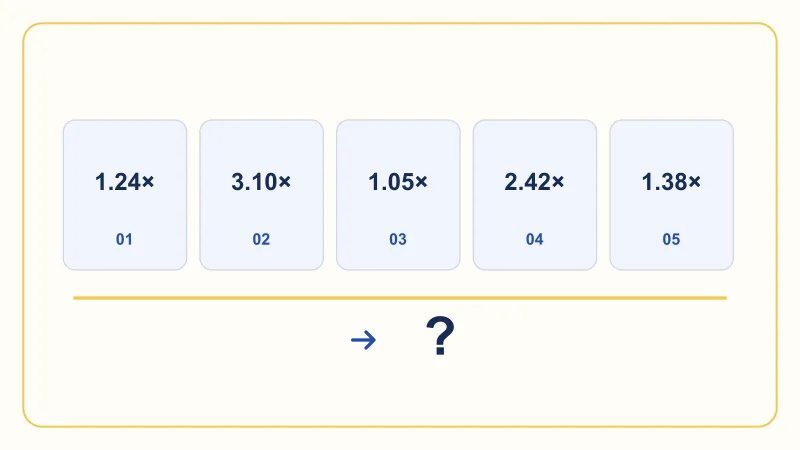
Write these invented completed values on paper: 1.24×, 3.10×, 1.05×, 2.42× and 1.38×. They demonstrate how to read five entries; they are not recorded Master Crash outcomes. Label the first and last entries. Notice that rearranging the order changes the story you might tell while leaving the set of numbers unchanged. That is why order and context matter.
- 1.24×
- 3.10×
- 1.05×
- 2.42×
- 1.38×
Example history · Next round: Unknown
A streak does not supply the missing rule
A few low values followed by a high one do not establish a repeating cycle. A longer history still needs the documented generation process before it can support a statistical claim. There is no next-round result encoded simply in the fact that earlier values were low. A history screenshot cannot validate a predictor service, a paid signal group or a guaranteed-result claim.
Personal records answer a different question
To investigate an action, use the record for that action rather than only the public round strip. Compare the round ID, accepted amount, accepted multiplier and status. The fact that a round eventually reached 4.00× does not mean your own action was accepted at 4.00×. A history strip might show where a round ended without showing when your request was received.
History is not a fairness certificate
A fairness claim needs a stated method and an actual way to verify the relevant record. A tidy chart, a long list of rounds or a certification-shaped badge is not that evidence. Read the provider’s documented mechanism and what it allows a reader to check. This website has not audited a Master Crash outcome generator or verified a fairness tool in the linked APK.
Keep the useful part of an enquiry
If the record is incomplete, note the app version, round ID, time with timezone and exact missing field. Use the verified help route in the installed app. Avoid posting private balances or identifiers in public groups. If you are only reading examples, leave the next result blank: that is the honest endpoint of a history exercise.
Match the round before comparing the values
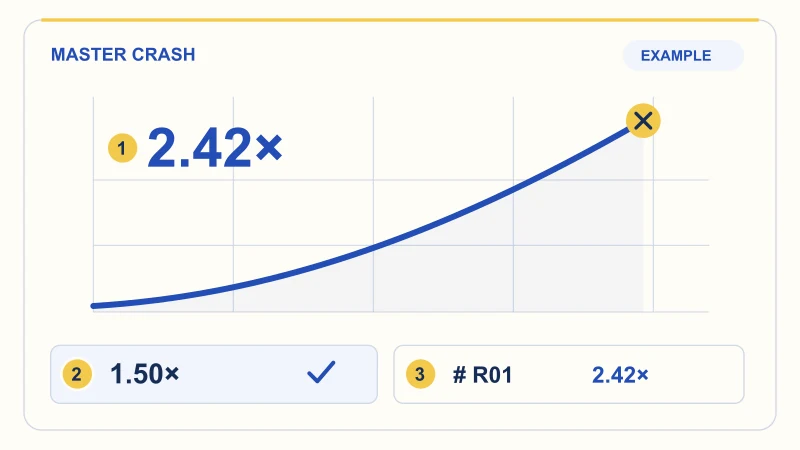
Suppose R01 ends at 2.42× and a personal action is recorded at 1.50×. These values can coexist: the first belongs to the completed round and the second to one accepted action. A public list of round endings and a personal action record may therefore show different numbers without referring to different rounds. Compare the round identifier, date and time first, then read each column label. A cropped image containing only a multiplier cannot establish whose action it describes.
If a completed round is missing
Check whether you are looking at public round history or personal activity, whether a filter is active, and whether the same account and session are open. Note the time zone shown by the record, if any. After a connection interruption, the visible list may need to refresh; do not assume a missing row means that no action was recorded. Preserve the round identifier and exact time. If the actual product provides an authenticated history or support channel, use it to resolve the missing entry.
| Record | Check first | What it cannot establish |
|---|---|---|
| Public round list | Round ID, time and end value | Your personal accepted action. |
| Personal activity | Same round ID, accepted value and status | The next round’s crash point. |
| Screenshot | Context, exact message and timestamp | A result without the matching record. |
 Aarav Sharma
Crash mechanics & rule guides
Covers Crash multipliers, cash-out terminology, round records and the evidence behind game claims.
Common questions
Do several low rounds make a high one due?
A short sequence does not establish a next-round forecast.
Are the example values real Master Crash results?
No. They are invented numbers for a paper-reading exercise.