
Crash guides
Crash multiplier explained: what does 2.00× mean?
Understand a Crash game multiplier, total return and the difference between a number on screen and a settled result.
Aarav Sharma · Updated · 3 min read
Read the multiplier as a factor
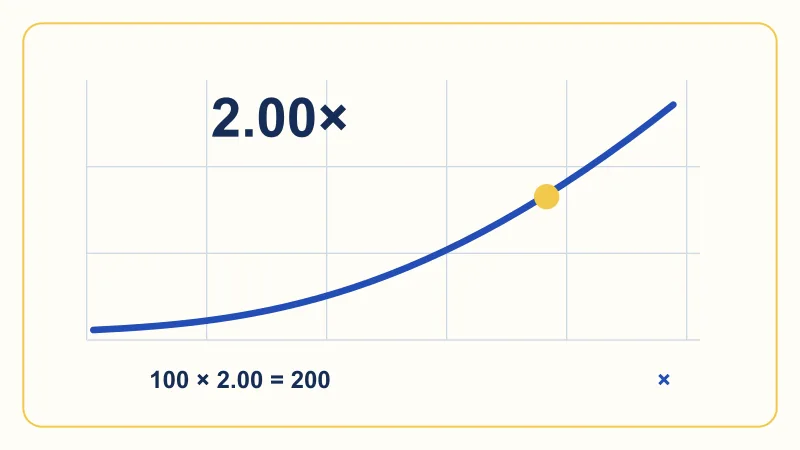
A multiplier tells you how many times a starting amount is being represented. In a typical Crash game, the counter starts around 1.00× and rises until the round ends. The moving line makes that change visible. The rocket or aircraft is a theme; the number and the rules carry the meaning. A larger number on screen does not establish a result for your own action.
Work through one paper example
Use 100 practice units written on paper. Multiplying 100 by 1.50 gives 150; multiplying it by 2.00 gives 200. These are arithmetic examples, not a playable demo or a payment promise. In a game that returns the starting stake as part of the total, 200 is the total return and 100 is the amount above the original 100. Check how the product labels these values.
100 practice units → Total return
Illustrative arithmetic; not a payout promise.
Separate the live value from the accepted value
The counter may move while a request travels from a phone to a server. The visible value when you press a control and the value recorded for an accepted action can therefore be different. Read the acknowledgement or round record rather than relying on the animation. The product rules should explain which event establishes the accepted multiplier and how it handles a late request.
Read decimals without rounding a rule
1.99× and 2.00× are different values. A rounded display, a target field and a settled value may each use a different number of decimal places. Do not assume that a display rounded to 2 means a 2.00× target was reached or accepted. Look for precision, rounding and any maximum-return rule in the game documentation. This website has not verified those settings in the linked APK.
A high multiplier is not a forecast
A large completed multiplier is one past observation. It does not tell you where the next round will stop. Likewise, a succession of small values does not establish that a large result is due. Understanding multiplication helps you read the display; it does not reveal an unreleased crash point. Avoid treating screenshots, chat messages or a calculator as proof of a future outcome.
What to check in the installed version
Find the actual multiplier label, the cash-out confirmation and the round record. Check whether totals include the starting amount, what units are used and where limits are documented. Keep an unclear example with its round identifier and time for a verified product support route. Version and checksum information on the download page identify the file, not its payout rules.
Compare two values from the same round
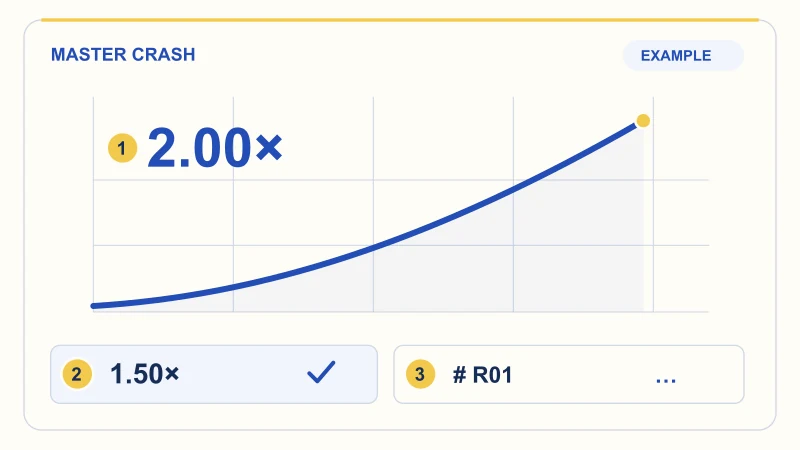
Use the illustrated round R01 as a reading exercise. The moving counter reaches 2.00×, while the accepted action field shows 1.50×. They describe different things: the first is the current round value and the second belongs to an already accepted action. If the starting amount is 100 practice units, the simple accepted-value calculation is 100 × 1.50 = 150 total units. Multiplying by the larger live value would describe a different, unconfirmed action. Check the field label before doing the calculation.
Read the amount label before the number
Write down the starting amount, the accepted multiplier and the name of the amount field. A field called total return can include the original amount; a field called profit may exclude it. In this paper example, 150 total units contain the starting 100, leaving a difference of 50. This distinction does not establish the product’s fees, rounding or payout policy. If the installed app uses another unit or definition, use its documented rule and keep all three fields together when asking about a discrepancy.
| Field | Example | How to read it |
|---|---|---|
| Starting amount | 100 units | Arithmetic input, not a recommendation. |
| Accepted value | 1.50× | Use this field for the accepted action. |
| Live value | 2.00× | The round is continuing independently. |
| Total / difference | 150 / 50 | Total includes the starting 100 in this example. |
 Aarav Sharma
Crash mechanics & rule guides
Covers Crash multipliers, cash-out terminology, round records and the evidence behind game claims.
Common questions
Does 2.00× mean a guaranteed return?
No. It explains a factor. A result depends on an accepted action and the game’s actual rules.
Can a multiplier chart predict the next crash?
A chart of completed rounds does not establish the next crash point.