
Card mathematics
Three-card probability: count the hands, not a winning streak
An independently calculated table of 22,100 three-card combinations, with clear assumptions and the limits of what percentages mean.
 Aarav Sharma · Updated · 2 min read
Define the experiment first
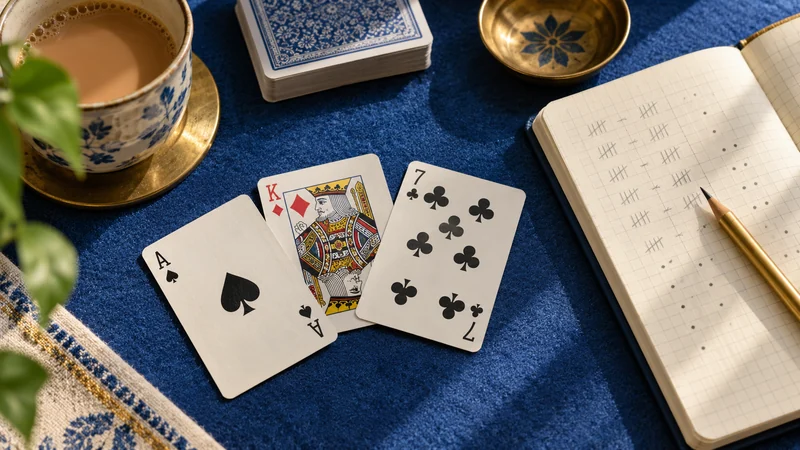
This calculation draws three different cards from a complete 52-card deck. Order does not matter, no cards are wild, and every three-card combination is equally likely. A-2-3 and Q-K-A are counted as sequences; K-A-2 is not. Changing any of these assumptions can change the table.
Why there are 22,100 combinations
There are 52 choices for the first card, 51 for the second and 50 for the third. That gives 132,600 ordered draws. Each group of three appears in six possible orders, so divide by 6: 22,100 unordered hands. Our build check enumerates every one and assigns it to exactly one category.
| Category | Hands | Share |
|---|---|---|
| Trail | 52 | 0.235% |
| Pure sequence | 48 | 0.217% |
| Sequence | 720 | 3.258% |
| Color | 1,096 | 4.959% |
| Pair | 3,744 | 16.941% |
| High card | 16,440 | 74.389% |
| Total | 22,100 | 100% |
52 cards · 3 drawn · no wild cards. Counts verified by exhaustive enumeration.
Read a percentage as a model, not a promise
The table gives the chance of receiving a category in that mathematical experiment. It does not give your chance of winning against other players. Opponents’ cards, revealed information, actions and table rules are outside this calculation. The values also do not establish how a particular app deals its cards.
Rarity and ranking answer different questions
Under these assumptions there are 48 pure sequences and 52 trails. A pure sequence is therefore slightly rarer, even though the common ranking puts Trail above it. A count describes how many hands exist; a rule defines which one beats another. Never replace the published ranking with the order of these percentages.
Why a previous hand is not a countdown
If the full deck is independently reshuffled for each new draw, an earlier result does not remove that category from the next draw. A run of ordinary hands does not make a rare hand “due”. If cards are instead kept out of the deck, the assumptions have changed and a fresh calculation is needed.
Reproduce the small calculations
For a trail, select one of 13 ranks and choose 3 of its 4 suits: 13 × 4 = 52. For a pair, choose its rank, 2 of 4 suits, a different rank for the third card and one of its 4 suits: 13 × 6 × 12 × 4 = 3,744. The category counts below add up to 22,100; displayed percentages are rounded independently.
Common questions
Are these the linked app’s published odds?
No. These are independently calculated card combinations under the stated assumptions.
Why can the rounded percentages miss 100% slightly?
Each row is rounded separately. The exact counts, which total 22,100, are the reproducible values.
Aarav SharmaGame guides & rule literacy
Covers how to read game rules, understand controls and distinguish displayed information from confirmed actions.