
Crash guides
Crash cash out and withdrawal: follow the money in stages
Follow a Crash result from the round to account credit and withdrawal. Know which record explains each stage and what to send when amounts differ.
Priya Mehta · Updated · 4 min read
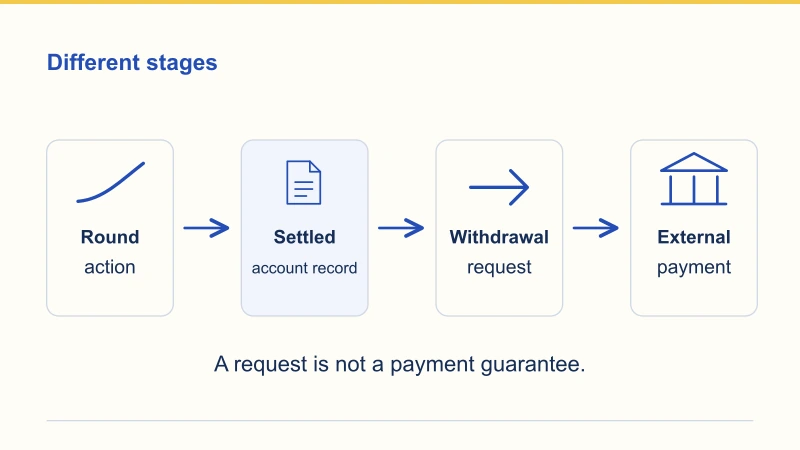
One phrase can hide three separate events
Cash out is the action inside a Crash round; settlement records its outcome in the account; withdrawal concerns moving account funds to an external destination. SPRIBE’s Aviator description uses cash out in the first sense. A successful round action therefore does not establish a completed bank payment. The amounts, references and balance labels below are invented, not screenshots, tested Master Crash features or promised processing steps.
Follow a small ledger from entry to account credit
Start the example with ₹200.00 in an account. A ₹25.00 stake leaves ₹175.00, assuming that stake is deducted immediately. A settled 1.80× return including the stake adds ₹45.00, taking the balance to ₹220.00. The net gain is ₹20.00. Nothing in those three lines sends money to a bank. Now imagine a separate ₹100.00 withdrawal request. If this fictional account reserves that amount, it could display ₹120.00 available and ₹100.00 pending withdrawal. That reservation is still not evidence of external receipt.
Use the next record to cross each stage
A round reference such as R204 identifies the game event. A settlement reference such as S907 identifies its ledger entry. A withdrawal reference such as W118 identifies a later payment request. An “accepted” message beside a round action cannot replace S907’s amount or W118’s status. Equally, a withdrawal may combine money from several earlier entries; there need not be one bank payment for each cash out. Match records using their stated links, not the similarity of amounts alone.
| Stage | Useful record | Question it answers | Does not prove |
|---|---|---|---|
| Round action | R204 and its entry reference | Which entry was closed, and at what recorded value? | External payment |
| Account settlement | S907 and amount labels | Which debit or credit was recorded? | Withdrawal receipt |
| Withdrawal request | W118 and exact status | Which amount was requested and how is it recorded? | Bank credit by itself |
| External receipt | Matching receiving-account entry | Was this transfer credited at the destination? | Every earlier game calculation |
When the round is recorded but the balance looks wrong
Compare the stake debit and settlement credit before looking for a bank transfer. Keep the balance labels: available, reserved and promotional amounts, if present, need not describe the same pot. In the example, adding the ₹45 return to the original ₹200 would incorrectly produce ₹245 because it forgets the ₹25 deduction. Other activity can also change the visible balance between screenshots. Take the account history for the relevant interval and identify each entry; a later balance alone cannot prove which game transaction is missing.
When a withdrawal is shown but receipt is missing
Move to the withdrawal record only after identifying the account movement. Preserve its exact status, amount, currency, requested destination type and last update. “Completed” in one system needs that system’s definition; it is not a universal label shared by every bank or payment provider. A receiving-account credit is separate evidence. If a transfer reference is supplied, retain it privately for the verified payment-support route. Do not send a public screenshot containing a full bank account, payment address, phone number or unrelated transactions.
Ask the team responsible for the missing stage
A game-result question needs the round and entry references, recorded cash-out value and result. A balance question needs the debit, credit and ledger references. A withdrawal question needs the withdrawal reference and exact payment status. Add the app version and the time with timezone when useful. Describe the gap in one sentence: “S907 records ₹45.00, but I cannot find its matching credit.” Use identifiers only in verified private support. Never include a password, OTP, UPI PIN or card security code in the request.
Measure a delay from the right event
The time you tapped cash out is not necessarily the start time of a withdrawal request made later. Write down each timestamp separately, including its timezone. If a service publishes a processing estimate, establish which event starts it, whether it describes processing or receipt, and which payment method it covers. This article promises no arrival time. A network interruption also does not establish a lost payment or an automatic refund. Keep the existing reference and ask for its current state rather than repeatedly resubmitting the same request or placing another entry to “unlock” money.
Keep the evidence narrow and the reference clear
Ask which record is authoritative when two views disagree, and retain the support case number with the reply. UKGC RTS 2 addresses clear transaction values; RTS 10 addresses interruption policies and recovery information. These are British reference standards, not Indian legal advice, a bank service guarantee or certification of this APK. Our ledger is an explanatory model: the actual product must supply its own balance definitions, payment records and documented support route.
Questions readers ask
Does cash out automatically mean a withdrawal was requested?
No. An in-round cash out does not, by itself, establish a separate withdrawal instruction. Look for a withdrawal record before asking where that payment is.
Is pending money necessarily missing?
Not from that label alone. Establish whether the amount is reserved, credited or part of another balance field, and identify the particular request it belongs to.
How long should a withdrawal take?
There is no universal time given here. Use the actual service’s published terms for the chosen method and preserve its request timestamp. A game result cannot supply a banking deadline.
 Priya Mehta
Responsible use & session planning
Covers session planning, personal boundaries and recognising when to pause. This content does not provide medical or financial advice.