
Crash guides
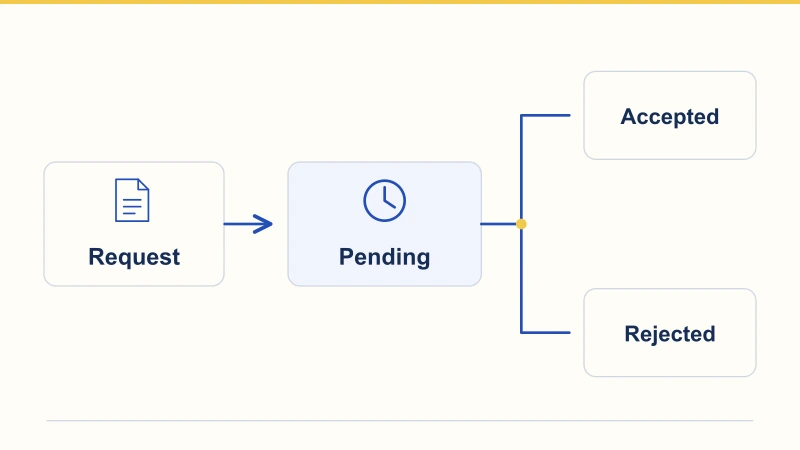
Pending, queued or rejected? Read a Crash action status
Compare six possible action statuses and work through three message examples, without confusing a pending request, cancelled entry or settled result.
Aarav Sharma · Updated · 4 min read
Read the whole message, not the coloured badge
“Accepted” leaves a question: what was accepted? An entry, a cash-out request and a changed setting are different objects. Start with the action name, its reference and the round it concerns. These messages are invented reading exercises. Products can use these words differently; this is not a list of features observed in the APK linked by Master Crash.
Use the table as questions to ask
Pending may describe an unfinished request; queued may point to a later round. Neither alone explains a result. Read the product’s definition alongside the label. If the screen truncates a message, open its details where available before drawing a conclusion from the first word.
| Status | Possible reading | What it does not establish |
|---|---|---|
| Pending | A named request has no final status here. | Acceptance, rejection or a return. |
| Queued | An action is waiting for a stated stage or round. | Participation in the round currently displayed. |
| Accepted | The named action was accepted for its reference. | That every later action succeeded. |
| Rejected | This particular request was not accepted. | That a separate accepted request was cancelled. |
| Cancelled | The named request or scheduled action was cancelled. | A refund, credit or reversal without its record. |
| Settled | The outcome was recorded under the product’s rules. | A win, profit or completed bank withdrawal. |
Case 1: pending and accepted refer to the same request
Imagine “Request Q81 · entry 40 units · round R104 · pending” at 20:05:10 IST. A later record reads “Q81 · R104 · entry accepted” at 20:05:11 IST. In this fictional sequence, the shared identifiers link the two messages: the later record confirms the entry, not a cash out or a return. Keep both times and their timezone. A timeout on the phone alone would not establish rejection. Repeatedly submitting an entry to test its status can create a separate request; it is not a status enquiry.
Case 2: a queued entry is cancelled for the next round
Suppose an illustrative panel says “Q82 · queued for R105”, then “Q82 · cancelled”. Another row still reads “Q81 · R104 · accepted”. The cancellation concerns Q82, not Q81. It cannot undo a different round just because both rows appeared on the same screen. Nor does the word cancelled prove that money was returned: the example does not say whether an amount was reserved or deducted. Any release or credit needs its own matching record and the product’s stated policy.
Case 3: a rejected request does not erase an accepted entry
A hypothetical message reads “Q83 · entry rejected · round closed”. Elsewhere, Q81 remains accepted for R104. The rejection applies to Q83; it says nothing about cancelling Q81. The reason is also limited: “round closed” describes this invented rejection, not a diagnosis of every failed request. Save the exact reason instead of translating all errors into “my internet failed”. If two records conflict, compare their request identifiers before treating one as a correction of the other.
Settled is a processing state, not a synonym for won
In a simple fictional ledger, a settled 40-unit stake with zero return gives a net result of −40 units. A separate settled 40-unit stake with 60 returned gives +20 units, when that return includes the stake. Both can be marked settled because their outcomes have been recorded. The status does not identify a bank transfer, guarantee profit or explain the calculation without its amount labels.
Make a note that preserves the question
Record the action, request reference, round reference, full message and time with timezone. Add the displayed amount and its unit only where relevant. Preserve an original screenshot privately; hide unnecessary account information in a copy shared with the product’s verified support. Ask a specific question such as “Which record resolves Q81?” rather than submitting another entry or posting account details in a public group.
Why the product’s interruption policy matters
The UK Gambling Commission publishes separate standards on clear transaction information, technical delay and interruptions. Their separation is useful: a visible message, a connection problem and the treatment of an interrupted action are different questions. These UK references do not establish Indian rules or this APK’s compliance. The operator’s own current instructions must explain which record is authoritative and how unresolved actions are handled.
Questions readers ask
Does pending mean my request failed?
No. The label alone does not settle that question. Find the later status for the same reference or use the product’s documented support route.
Does cancelled always mean a refund?
No. An action may have been cancelled before any deduction, or a balance adjustment may have its own record. Match the request to the actual amount entries.
Can two different statuses both be correct?
Yes. They may concern different requests, rounds or stages. Preserve their identifiers and timestamps rather than comparing isolated badges.
 Aarav Sharma
Crash mechanics & rule guides
Covers Crash multipliers, cash-out terminology, round records and the evidence behind game claims.