
Crash guides
Crash predictors: what would count as evidence?
Examine Crash predictor claims using timing, complete records and simple arithmetic. Learn why checking a finished round does not reveal the next one.
Priya Mehta · Updated · 5 min read
First, give the claim a deadline
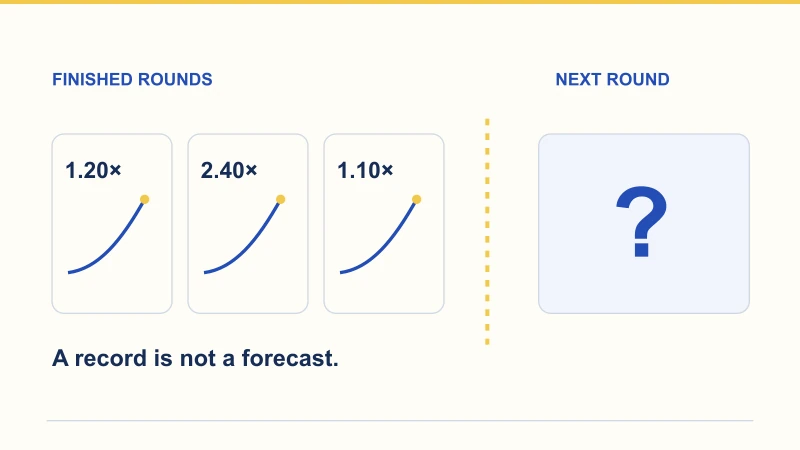
Imagine a message naming round R1042 and a crash point of 2.42×. The same message means very different things before that round begins and after its result is public. Evidence of prediction needs the original message, an independently recorded time and an unambiguous round identifier. A claim that a round will exceed 2.00× is also different from predicting its exact endpoint. Decide what counts as a correct claim before looking at the outcome. Otherwise a vague message can be reinterpreted to fit almost any result.
What a provably fair page can show
SPRIBE describes publishing a server-seed hash before a round, combining server and player seeds, and making round details available for later verification. Its process is an example of checking a disclosed record, not an offer to reveal future crash points. Timing is the key distinction. An explanation of how a finished result can be reproduced does not say that every input was available beforehand. A tool that correctly reproduces yesterday’s result has demonstrated a calculation with supplied inputs. It has not, through that demonstration alone, shown access to tomorrow’s missing inputs.
A hash is not the secret written in another font
NIST’s definition of preimage resistance describes the difficulty of finding an input from its cryptographic hash. A published hash is therefore not a seed waiting for an ordinary decoder. With an appropriately designed system, it can help commit to information without disclosing that information in advance. Think of an original envelope analogy: matching the seal after opening is a different task from knowing the contents while it is closed. This analogy explains the timing; it is not a security audit. Weak inputs, implementation defects and disclosure mistakes require separate evidence, not assumptions about a named product.
| Material shown | What it may demonstrate | What is still missing |
|---|---|---|
| A finished-round calculation | The supplied inputs reproduce a result | A forecast made before disclosure |
| Eight successful screenshots | Eight selected examples | The full number of attempts |
| A 90% accuracy label | A claimed score | Task, dates, complete record and comparison |
Screenshots need a sequence, not just a matching number
A cropped screenshot may show 2.42× beside a successful result while omitting the message’s original time. A local phone clock, an edited caption or a delayed video does not settle which came first. A more useful record preserves the original prediction, later result, round identifiers and timing evidence together. If a clip begins after the prediction is supposedly made, the missing beginning matters. Likewise, a genuine result screenshot can be paired with an unrelated message. These are limits of the evidence format; they do not establish that every creator using that format is dishonest.
Count the messages that did not make the highlight reel
Consider an invented record with 40 dated predictions: eight correct and 32 incorrect under a rule fixed in advance. The success rate is 8 ÷ 40 = 20%. Showing the eight successes alongside only two failures creates a different-looking 8 ÷ 10 = 80% presentation. No prediction improved; the selection changed. That is why deleted messages, skipped rounds and undefined outcomes matter. A total should say how each was handled. Ten attractive screenshots cannot establish an accuracy rate when the number of attempts is missing. Keep the full denominator attached to any percentage.
Accuracy also needs a useful comparison
Suppose an invented set of 100 rounds contains 90 outcomes below 5.00×. A message saying below 5.00× on every round would match 90 of them without distinguishing any individual outcome. This is a lesson about a common outcome dominating a score, not a suggested betting rule. A claimed 90% accuracy needs the task definition and a comparison with a simple fixed answer. Exact endpoints, broad ranges and yes-or-no labels cannot share one score without explanation. Even a well-defined retrospective score does not establish that future observations will follow the same pattern.
An AI label does not fill the missing evidence
A service may describe its output as AI, an algorithm or a signal. Those labels do not supply the prediction’s timestamp, complete results or the information available when it was made. A model fitted to old rounds may describe those rounds closely while performing differently on later data. A convincing evaluation would separate the material used to build the method from later observations used to assess it. It would preserve failures and avoid changing success definitions after seeing outcomes. A payment receipt or access to a private group answers none of these measurement questions.
Keep verification, prediction and account access separate
A round verifier asks whether disclosed inputs reproduce a recorded result. A predictor claims information about a result that is still unknown. Account access is a third matter: a request for your password, OTP or remote control of a phone does not prove either claim. You do not need to fund an account or install an unknown tool to see whether a public claim even includes a complete record. This article does not test or endorse a predictor, or accuse a particular app of fraud. It gives a practical standard for judging what the evidence actually establishes.
Questions readers ask
Does provably fair mean the next crash can be calculated publicly?
No. A method for verifying disclosed round information does not imply that all inputs to a future round are already public.
Is a high accuracy percentage enough?
No. The task, full number of attempts, timing and a meaningful comparison all matter.
Does this article prove a particular predictor is a scam?
No. It examines types of evidence and original examples. It makes no finding about a named service or app.
 Priya Mehta
Responsible use & session planning
Covers session planning, personal boundaries and recognising when to pause. This content does not provide medical or financial advice.